Life-Changing Words

I spoke yesterday to several thousand people at the national Society for Human Resource Management conference in San Diego, CA. My presentation was titled “The Simple Truths of Service Inspired by Johnny the Bagger®,” and like the book and the story, it focuses on the ten simple truths of service, choices we have in every interaction, and how one person can make a difference.

I ended, as I do every presentation I give, with a thought from a precious friend of mine, Og Mandino, who passed away several years ago. (He told me once that he had sold enough books to go five times around the equator! His most famous book is “The Greatest Salesman in the World.”) I always ask the audience to close their eyes as I share Rule #10 from his book, “A Better Way to Live:”

“Beginning today, treat every person you meet, loved one or stranger, friend or foe, as if they were going to be dead at midnight. Extend to each person you meet, no matter how trivial the contact, all the care and kindness and understanding and love that you can muster. And do so with no thought of any reward. Your life will never be the same again.”

The audience was wonderfully responsive, and I even received a quick standing ovation at the end. The rest of the afternoon people kept coming up to me as they met me in the hall to thank me and tell me how much my words had meant to them; however, one person made me realize how important it is for me to constantly be aware that I am just the messenger. (My friend Ken Blanchard’s definition of “ego” is “edging God out!”)

She shared that the night before she left for the conference, she and her husband had had a terrible fight and they had not spoken since. She said as soon as I had finished speaking that day, she went out, got her phone, and called him to talk it through and apologize. She said, “After hearing those words, my life will never be the same again.”

What a blessing it is to remind people of how important it is to love and care for one another, whether the person is a family member, a colleague, a customer, or just someone you happen to meet in passing. Like Johnny, we can ALL make a difference every single day. Whose day will you brighten today?

To learn more about Barbara’s presentations.

To order the movie or the book about Johnny the Bagger®, go to Barbara’s Products.
Managers need recognition, too!

The principle of giving appreciation is basic to all the work I do. As a member of Recognition Professionals International, I have been reading an interesting dialogue about the issue of rewards and recognition for managers. One member shared about a fun, immediate reward that has been instituted for employees in her company called “You Rock!” The idea is that when an employee does something special for a colleague, they receive a rock from that person to put on their desk as a symbolic reward for having done good work. Then, they are to pass that rock on in the next week to someone who serves them in an extraordinary way. Although this was not designed to include management, one of the employees gave his rock to a senior person who had not completely bought into the idea — this manager had thought it was a bit silly. After receiving the rock, however, he expressed how good it made him feel and that he now understood why this small bit of praise and recognition DID make a difference.

In his “KnowHR” blog (and reprinted in the Fall 2009 issue of the “Conference Board Review”), Frank Roche spoke succinctly and brilliantly on this point:

“I don’t remember what age I was when I noticed that people no longer told me that I was doing a great job. It’s not like I stopped doing good work — it’s that people think that once you get to a certain age or certain place in life that you don’t need praise anymore. … But what I do realize is that people need praise throughout their careers. Senior managers like to hear that they’re doing well as much as they did when they were junior functionaries. It applies to everyone — the price of praise is free. Tell someone today.”

So, no matter what our level, our age, or our job, we all need to be appreciated. Who can you appreciate today?

NEED IDEAS TO APPRECIATE PEOPLE? Each of Barbara’s books with “CARE” in the title, “CARE Packages for the Workplace,” “CARE Packages for the Home,” “Handle with CARE,” and “CARE Packages for your Customers”, all have a whole chapter on “Appreciation” filled with low cost or no cost ideas you can use every day. Also, you will love “The Simple Truths of Appreciation — How Each of Us Can Choose to Make a Difference.” It is filled with stories of ways people have appreciated one another in all walks of life.

To order any of Barbara’s books, go to . www.barbaraglanz.com/products/books/.

My Mother at 92 Years of Age!

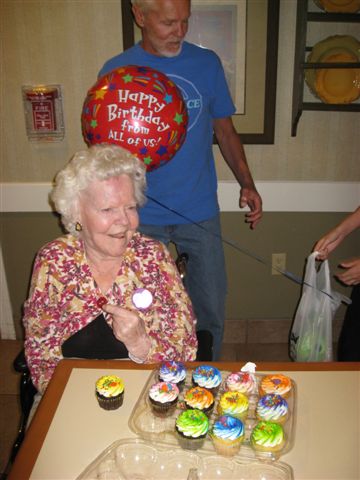
My mother, Gertrude Lucille Bauerle, turned 92 in May. Although she no longer talks or takes care of herself because of dementia, she still looks beautiful. She is always smiling, and the people at the home love her because of her sunny attitude. I just finished reading the book, “Still Alice” by Lisa Genova, about a woman who is a Harvard college professor and gets early onset Alzheimers at the age of 50. The book is written from her perspective, and what touched me the most is that even though she could no longer respond, inside she was “still Alice,” still thinking and feeling just as she did before. It made me so much more cognizant of those people we care about who develop dementia and Alzheimers and how important it is for us to treat them with just as much respect and care as we did before, rather than simply talking around them. I strongly recommend this book (although it is a bit scary when you see yourself having some of the same symptoms! 😉

Mother celebrating her 92nd birthday in Grand Junction, CO

University of Kansas Mini-College

A Lifelong Learning Adventure

Last week I was privileged to take part in a wonderful life learning experience – a week of lectures and classes on the campus of KU taught by top college professors to a group of educated and interesting adults. The professors who taught each of the nearly 75 different 90 minute sessions were all volunteers who had to “apply” to be a part of the week. The Dean of the College of Liberal Arts and Sciences, for example, good-naturedly told us in his address that he wanted to teach a class but had gotten turned down! He shared that the goal of Liberal Arts is “To understand what it means to be human,” and that was certainly the purpose of this week.

Barbara and the KU Jayhawk

It was interesting that the professors all week told us how much they were enjoying us as an audience – we came on time, listened, asked insightful questions, and did not sit texting on our cellphones! 😉 . Interestingly, they nearly all talked about the “silver tsunami” –that the % of people over age 65 will double in the next two years and the implications that will have for our society.

We individually ahead of time planned our “curriculum” which consisted of choices from diverse areas of learning, including politics, religion, science, education, life skills, film, history, and art. We were each able to experience fifteen 90 minute classes and several lectures and addresses to the entire group as well as walking, museum, and bus tours.

Carolyn, Barbara, and Karna, all mini-college attendees!

The full group presentations during the week included addresses from the Dean of the College of Liberal Arts and Sciences, the Chancellor of the University, a film screening of “The Only Good Indian,” Steve Hawley, an astronaut from NASA (participated in 5 shuttle missions) who spoke on “Inside Space,” a session on “Flamenco for Everyone,” and a presentation on “From the Golden Valley to Silicon Valley-A New Era of Cancer Treatment” from the Executive Chairman of Genomic Health.

Strong Hall, the Administration Building

This was my schedule of classes with several of the major learnings from each:

“The Psychological Toxicity of Modern Life”—Stephen Hardi

• 99.9% of our existence as a species was as Hunter –Gatherers. Our bodies were designed for a different time and place. Diseases of modernity include – Obesity, Diabetes, Hardening of the Arteries, Asthma, Fibromyalgia, Cancer, Depression.
• 70% of adults are clinically overweight. Today our appetites are calibrated to sugar, salt, fat and starch rather than the natural foods of our ancestors.
• 50% of all American adults will be diagnosed with a serious mental illness at some time in their lives. Depression can cause brain damage because cortisol, the chemical produced by depression, turns off brain growth. Chronic stress is toxic!
• The average American teenager spends 7 ½ hours a day in front of a screen, not counting the 1 ½ hours of texting. Today’s lifestyle is an environmental mutation. Depression is 10X lower in the Amish society, for example, because of their simpler lifestyle.
• BCNF is the brain growth hormone. It can grow new connections and repair brain damage at any age. Exercise stimulates BCNF – 40 minutes of brisk walking 3X a week is recommended. A couch potato measures 10 – 15 years older for biological age while regular exercisers measure 10 – 15 years younger.
• Single best current marker for heart disease – CRP, a blood test that measures inflammation. Meta-analysis pooling all studies proves that regular aerobic exercise is better than a stent after a heart attack.
• 80-90% of Americans get sub-optimum levels of vitamin D3. It is an anti-inflammatory that regulates our immune system. We NEED sunlight!
• Ways to combat this toxicity:
Physical Exercise—single most important medicine
Omega-3 Fats
Sunlight
Social Connection
Healthy Sleep
Engaging (anti-ruminative) Activity
• His book is “The Depression Cure” by Stephen Hardi
(Note: This was one of my favorite sessions!)

The Campanile which is the most famous landmark at KU. You walk through it and down the hill at graduation.

Read More…